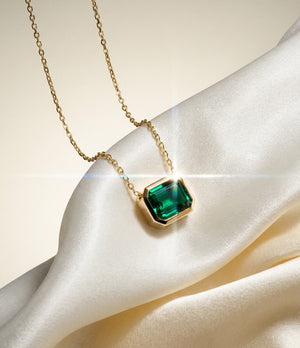
An emerald cut diamond set east to west in compass prongs on a yellow gold band, on green velvet

Education 8 min read Updated

East-West Engagement Rings: What They Are and Which Diamonds Work Best

A Long Diamond, Turned Across the Finger

An east-west ring sets an elongated diamond sideways, so its length runs with the band instead of along the finger. Here is what that changes, which shapes suit it, how it wears, how a wedding band sits beside it, and the east-west rings we make.

How our guides are checked: Mine & Grown guides are reviewed for accuracy. Questions about a specific piece? Yareli, our founder and designer, can help by video or phone.

Elowen oval engagement ring worn on the hand

The Short Answer

An east-west engagement ring sets the center diamond sideways, so its long side runs across the finger, in line with the band. You may also see it called a horizontal or sideways setting. The traditional direction, from knuckle to fingertip, is called north-south.

The diamond keeps its carat weight, cut, color, clarity and grading report. The ring's outline changes, and the stone reads wider on the hand.

Long shapes work best: oval, emerald, pear, marquise and radiant. Round and square diamonds look the same either way. Plan the wedding band early, because a wide, low stone can keep a straight band from sitting close. Our east-west rings are the Elowen and Lumi, and our Ivy Pear lays a pear sideways beside a small round.

Every Shape, Turned Sideways

ShapeTurned sidewaysWidth across the finger (our search)What to watch for
OvalA soft, wide outline with no corners or pointsAbout 8.0 mm at 1 carat, 10.1 mm at 2 caratsAny bow tie stays when the stone is turned, so judge it on video
Emerald cutLong step facets run across the finger, like a window on its sideAbout 6.9 mm at 1 carat, 8.6 mm at 2 caratsStep facets show inclusions more easily, and open corners need care
Radiant cutA clean rectangle with lively sparkleAbout 7.1 mm at 1 carat, 8.9 mm at 2 caratsSome radiants are nearly square and barely change, so check the ratio
PearPoints across the finger, toward one side of the handAbout 8.9 mm at 1 carat, 11.3 mm at 2 caratsThe point is exposed, so check what protects it
MarquiseA long, narrow line across the fingerAbout 10.5 mm at 1 carat, 13.2 mm at 2 caratsThe widest spread of these shapes, with two points to protect
CushionChanges only if the stone is cut longer than it is wideDepends on the stone's ratioMany cushions are close to square, so ask for the length and width
RoundNo change: a circle has no long sideAbout 6.4 mm at 1 carat, 8.1 mm at 2 caratsOnly the prongs or band can show the turn
Princess or AsscherNo change when the stone is squareAsscher: about 5.5 mm at 1 carat, 7.0 mm at 2 caratsA 45 degree turn is a different look, as on our Astra Asscher
Elowen oval engagement ring in yellow gold on green velvet

What Changes When You Turn a Diamond

Turning a diamond changes how much of the finger it covers. The top of the stone keeps the same area, but its length now runs across the finger.

A 2 carat oval in our diamond search is typically about 10.1 mm long and 7.1 mm wide. Set north-south, it spans 7.1 mm of the finger; set east-west, 10.1 mm. A size 7 ring is about 17.3 mm across inside, so that is about 41 percent of the width against about 58 percent. So a sideways stone can look larger on the hand at the same carat weight.

The cut stays the same too. Turning an oval does not remove a bow tie, because the facets move with the stone. Beyond the 4Cs explains proportions and ratios.

Lumi pear engagement ring in yellow gold on green velvet

East-West vs North-South vs Diagonal

North-south draws the eye along the finger, and east-west draws it across the hand. A diagonal setting sits between the two, with the stone at an angle.

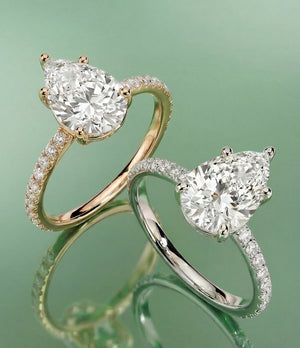
Our Isadora Oval sets an oval on a gentle diagonal inside a bypass band, and our Eclipse Marquise lays a marquise on a diagonal across two rails of gold. The Lumi Pear, pictured here, belongs to our east-west family, and its pear sits on a diagonal, with the point following the arc of the band.

A marquise diamond and an oval diamond of the same carat weight side by side, face up

Which Diamond Shapes Work Best for East-West

The longer a stone is for its width, the more turning it changes the ring. That measure is the length-to-width ratio. In our diamond search the typical marquise is about 2.00, pear about 1.60, emerald about 1.45, oval about 1.44 and radiant about 1.42.

  • Oval. A soft, wide outline with no tips to protect.
  • Emerald and radiant. Clean rectangles, and the narrowest of the five at the same carat weight. An emerald's long step facets run across the finger; a radiant adds livelier sparkle.
  • Pear. The only one with a direction: the point aims toward one side of the hand.
  • Marquise. The longest of the five, so it makes the strongest line across the finger.

Within any shape, a lower ratio reads closer to round or square when turned. For a stronger sideways look, choose a higher ratio.

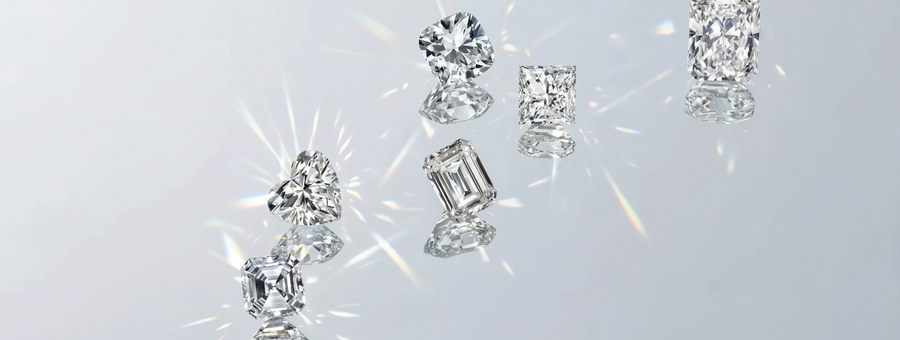
Cushion, radiant and princess cut loose diamonds in a row on a pale surface

Why Round and Square Diamonds Do Not Change

A round diamond has no long side, so turning it changes nothing. A square princess or Asscher has four equal sides, and a quarter turn gives the same outline. Only the prongs and band can change the look. A 45 degree turn is a different idea: our Astra Asscher stands its stone on its point.

A cushion can go either way: many are close to square, and others are cut longer. Miley Cyrus wears one set east-west. Radiants can also be nearly square, so in either shape, check the length and width on the grading report first.

Lumi marquise engagement ring worn on the hand

How an East-West Ring Looks and Wears on the Hand

Some jewelers say a sideways stone makes fingers look longer, and others say north-south does that. The effect is modest. Our Diamond Size Guide shows each shape and carat to scale, and its East West setting turns the stone across the finger.

A 2 carat marquise spans about 13.2 mm, about three quarters of a size 7 finger, and more on a smaller finger. A very wide stone can reach toward the fingers beside it, so compare its length with your finger.

A low stone catches on sleeves less than a tall one, but height depends on the setting. We found no test comparing the two directions, so treat any claim that one snags less as opinion.

Lumi marquise engagement ring in yellow gold on green velvet

Protecting the Points and Corners

Direction alone does not make a ring less secure. The prongs or bezel hold the stone either way, so look at what guards its exposed parts.

  • Pear and marquise. The points are the thinnest part of the stone. Set sideways, they face the fingers beside them. Look for a prong, V-prong or bezel near each point.
  • Emerald and radiant. Cut corners have no sharp tip. Compass prongs at the center of each side, as on our Elowen, leave them open, so take care around hard knocks.
  • Oval. No points or corners to guard.

Have the prongs checked about every six months. Our care guide covers the routine, Setting Types compares prongs and bezels, and Ring Anatomy 101 explains the parts of a ring.

Elowen oval engagement ring, upright view through the band

Will a Wedding Band Sit Flush?

It depends on how high the stone sits, which is why you will read both answers. A straight wedding band can often slide under a raised stone. If the stone sits low, a straight band meets it and leaves a gap.

Look at a ring from the end, as in this photo of the Elowen Oval: the shoulders rise to a narrow setting, with the stone above them. If you plan to wear a band, tell us, and we can check how the two sit together before your ring is made.

A pear diamond engagement ring with a contoured wedding band

Wedding Bands That Suit a Sideways Stone

  • A straight band with a small gap. Many people like the space it leaves.
  • A contoured or notched band. Shaped to follow the stone, it closes the gap, as in this photo of a pear set the traditional way.
  • An open band. A gap in the middle of the band lets the stone sit between its ends.
  • One ring alone. A band can also go on another finger or the other hand.

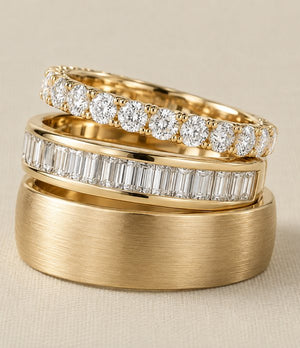
Which Wedding Band Goes With Your Engagement Ring? goes through the options, and Ring Stacking 101 has more pairing ideas.

Elowen radiant engagement ring in yellow gold on green velvet

Our Elowen: The East-West Solitaire

The Elowen is a single diamond turned across the finger, held in compass prongs. It comes in four shapes. The Elowen Oval has prongs at the top, bottom and sides, leaving almost all of its outline open. The Elowen Pear points across the finger, and its shoulders rise straight up to a narrow setting. The Elowen Emerald and Elowen Radiant have a prong at the center of each side and open corners.

It uses about 4.0 to 4.7 grams of 14k gold at a size 7. See our other solitaire engagement rings.

Lumi oval engagement ring in yellow gold on green velvet

Our Lumi: East-West on a Wave Band

The Lumi sets the diamond in the curve of a sweeping wave band, and the band crosses itself beneath the stone, so the ring reads as one continuous line. The Lumi Oval, pictured here, and the Lumi Marquise lie east to west in four prongs, with one side of the gold rising behind the stone. The Lumi Pear sits on a diagonal in three prongs.

The wave uses more gold, about 6.4 to 6.5 grams of 14k at a size 7. A straight wedding band will not follow its curve, so expect a gap beside it, or wear the Lumi alone.

Ivy pear toi-et-moi engagement ring in yellow gold on green velvet

Our Ivy: A Sideways Pear and a Small Round

The Ivy Pear is a toi et moi ring: a sideways pear diamond with a small round tucked against its rounded end, on a wide, flat polished band. You choose the pear, and the round, 1/4 ct. tw., comes with the setting.

Our toi et moi guide explains the tradition, and our toi et moi rings show other pairings.

Elowen pear engagement ring worn on the hand

How to Choose an East-West Ring

  1. Pick the outline. A soft oval, a crisp rectangle, or the points of a pear or marquise.
  2. Check the length and ratio. A stone's length becomes its width on your finger, and a higher ratio makes a stronger sideways look. Find the measurements on the grading report or in our diamond search.
  3. Ask where the prongs sit. Especially at points and corners.
  4. Plan the wedding band now. Close, with a gap, or not at all.
  5. Ask us. Our Elowen, Lumi and Ivy rings are made to order in our Chicago studio in about 4 to 6 weeks, in 14k yellow, white or rose gold, 18k yellow or rose gold, or platinum, with a lab-grown or natural center from 1.0 to 4.5 carats and an IGI or GIA report. Book a video or phone call with Yareli, our founder and designer. For a shape we do not list east-west, such as an elongated cushion, our custom process starts the same way.

East-West Engagement Ring FAQ

What is an east-west engagement ring?

An engagement ring whose center diamond is set sideways, with its long side running across the finger in line with the band. It is also called a horizontal or sideways setting. The traditional direction, along the finger, is called north-south.

Which diamond shapes look best in an east-west setting?

Long shapes, because they change the most when turned: oval, emerald, pear, marquise and radiant. An elongated cushion works too. A round or square diamond looks the same when turned, because its outline does not change.

Does an east-west setting make a diamond look bigger?

The top of the stone stays the same size, but it takes up more of the finger's width, so it can look larger on the hand. A typical 2 carat oval spans about 10.1 mm set east-west and about 7.1 mm set north-south.

Can a round diamond be set east-west?

It can, but you would not see a difference in the diamond, because a circle has no long side. Only the prongs or band could show the turn. For a visible sideways look, choose an elongated shape.

Will a wedding band sit flush with an east-west ring?

It depends on the height of the setting. If the stone is raised, a straight band can often slide beneath it. If it sits low, a straight band leaves a gap. A contoured or notched band can close the gap, and many people like the gap as it is.

Are east-west rings less secure, and do they snag more?

Direction alone does not make a ring less secure, because the prongs or bezel hold the stone either way. A low setting usually catches less than a tall one, whichever way the stone faces. On a pear or marquise, check how the points are protected, since they face the fingers beside them.

Is an east-west ring just a trend?

Not only. Many articles call it one, but jewelers tie the setting to the Art Deco era of the 1920s and 1930s. We have no figures on how many people choose it today, so choose it because you like the look.