A marquise engagement ring with a curved diamond wedding band fitted around its point, in yellow gold on dark green

Education 8 min read Updated

Which Wedding Band Goes With Your Engagement Ring? A Guide by Shape and Setting

Straight, Curved, Notched or Shadow, for Every Diamond Shape

The height of the setting decides most of it, and the shape of the diamond decides the rest. Here is the usual band for each shape and setting, when a straight band leaves a gap, and how to check the fit before you commit.

How our guides are checked: Mine & Grown guides are reviewed for accuracy. Questions about a specific piece? Yareli, our founder and designer, can help by video or phone.

The Short Answer

The Short Answer

Choose by the setting first, then the shape. If the diamond sits high enough for a band to slide under it, a straight band usually sits close, whatever the shape. If the setting is low or wide, a straight band stops against it and leaves a small gap. A curved or notched band closes that gap.

By shape, round, Asscher, emerald and radiant rings pair most easily with a straight band. Ovals go either way. Pears and marquises, the longest shapes, most often take a curved or V-shaped band. By setting, halos, three stones and toi et moi rings are the most likely to need a curve.

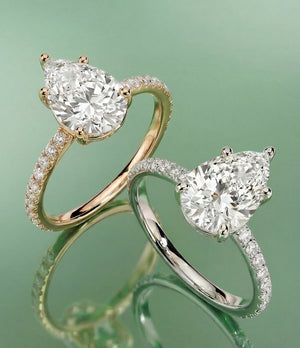
A small gap is normal, and many people like it. In this photo, the oval wears a straight band and the pear a curved one.

Wedding Bands by Diamond Shape at a Glance

ShapeUsual bandDoes a straight band leave a gap?Length at 2 carats
RoundStraight, plain or pavéRarely on a raised setting; a small one on a low settingAbout 8 mm
OvalStraight or a soft curveLittle or none on a raised setting; often a small one on a low settingAbout 10 mm
PearSoft curve or chevronOften, unless the setting is raisedAbout 11 mm
MarquiseChevron or curveUsually on a low setting, because a point reaches toward the band; less often on a raised oneAbout 13 mm
EmeraldStraight; some jewelers prefer a soft curveRarely on a raised setting; an even one on a low settingAbout 9 mm
AsscherStraightRarely on a raised setting; a slim one on a low settingAbout 7 mm
RadiantStraight or a soft curveRarely on a raised setting; sometimes on a low settingAbout 9 mm
Luna oval solitaire engagement ring, side profile

Why a Gap Appears

The diamond sits above the engagement ring's band and reaches past it on each side. If there is open space under the diamond, a straight band slides into that space and the two bands touch. If the setting comes down to the finger, a straight band stops against it, and a gap stays between the two bands.

Jewelers call a setting raised enough for a straight band "wed fit" or "flush fit." To check a ring, look at it from the side, as in this view of our Luna Oval, and see whether there is space under the stone.

Length matters too. In our diamond search, a typical 2 carat round is about 8 mm across, an oval about 10 mm long, a pear about 11 mm and a marquise about 13 mm. The longer the stone, the further a low setting holds a straight band away.

Straight, Curved, Notched and Shadow Bands

Straight, Curved, Notched and Shadow Bands

  • Straight band. Even all the way around. It can be worn alone and sits close on a raised setting.
  • Curved or contour band. Bends around the center stone. A soft curve follows a rounded shape, and a chevron, or V, cradles a point. It closes the gap, but it is shaped around one ring and can look unfinished when worn alone.
  • Notched band. A straight band with a small cutout where the base of the setting fits. It keeps the straight line on a low setting.
  • Shadow band. Often a band that closely mirrors the engagement ring. Some jewelers use the name for a simple band with a cutout or dip that fits around the head.

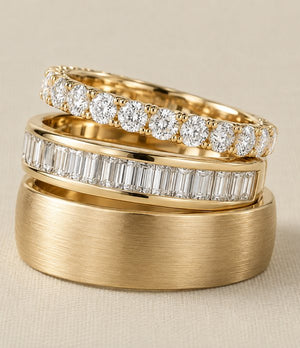
Jewelers use these names loosely, so judge a band by its shape, from the top and the side. This stack puts straight bands above a marquise and a band with a dip for the point below it. For metal and diamond styles, see Wedding Ring Types 101.

Wedding Bands for Round and Oval Rings

Wedding Bands for Round and Oval Rings

Round. A round diamond is the easiest shape to pair. It reaches less far along the finger than any other shape here except the Asscher. Most round solitaires take a straight plain or pavé band, as in this stack. A low round setting may leave a small gap, which a soft curve closes.

Oval. An oval set lengthwise reaches further, so a small gap is common on a low setting, and its curved outline can leave a wedge-shaped space beside a straight band. A raised oval takes a straight band well. From there the choice is about looks: a curve follows the outline, and a straight band adds a clean line.

A pear diamond engagement ring with a contoured wedding band

Wedding Bands for Pear and Marquise Rings

Pear. A pear has a round end and a point. Worn with the point toward the fingertip, the traditional way, its round end meets the band, and a soft curve or gentle V follows it, as in this photo. Worn with the point toward the hand, a V-shaped chevron cradles the tip.

Marquise. A marquise has a point at each end and the longest outline here, so one point always faces the band, and chevrons and curved bands are common. A notched straight band is the plainer alternative.

Neither shape requires a curve. On a low setting, a straight band usually leaves a small gap, and some people prefer that look.

Lyra emerald engagement ring worn on the hand

Wedding Bands for Emerald, Asscher and Radiant Rings

Jewelers disagree about emerald cuts. Some recommend a straight band because it repeats the stone's parallel lines. Others prefer a soft curve that hugs the stone. The setting usually settles it: on a raised setting, a straight band sits close and looks cleanest; on a low one, a soft curve or a notch closes the gap.

The shape itself helps a straight band. The short end of an emerald cut is a straight edge, so on a low setting any space beside a straight band stays even, without the wedge shape an oval can leave. It is also shorter than an oval of the same weight: about 9 mm against about 10 mm at 2 carats.

The same thinking applies to an Asscher, which at about 7 mm is the shortest shape here, and to a radiant, which usually shares the emerald cut's rectangular outline and is about 9 mm long.

A yellow gold oval halo engagement ring stacked with a curved pavé band, reflected on a pale green surface

Wedding Bands by Setting: Solitaire, Halo, Three Stone and Toi et Moi

  • Solitaire. A solitaire usually holds the diamond above the band, so a straight band usually sits flush.
  • Hidden halo. The row of small diamonds sits under the stone, and a straight band usually sits close. Check the side view, because that row is what a band will meet.
  • Halo. The halo is wider than the band below it, so a straight band may leave a small gap. A curved pavé band follows the outline, as in this photo, and a notched band also fits. Halo vs Hidden Halo vs Solitaire has more.
  • Three stone. The side stones widen the top of a three stone ring, so a straight band may leave a small gap. A curved or contoured band fits around them.
  • Toi et moi. Two stones spread across the finger and the band often curves, so a straight band may not sit flush. A curved band fits, and many couples treat a small gap as part of the look. See our Toi et Moi guide.
A bezel-set round diamond ring beside a textured yellow gold band on cream linen

Wedding Bands for Bezel and East-West Rings

Bezel. A bezel setting wraps the stone in a rim of metal and often sits low, which leaves little room for a band to slide under. A straight band stops against the rim and can leave a small gap. A soft curve or a notch closes it. A plain straight band beside a bezel, as shown here, is a clean look if you do not mind the space.

East-west. An east-west ring turns the stone so its long side lies across the finger. A 2 carat oval then takes up about 7 mm of the finger's length instead of about 10 mm, so a straight band often sits closer than it would beside the same stone set lengthwise. Our Elowen Oval is set this way. A wide setting that reaches below the stone may still need a contoured band.

A wide white metal ring with an oval diamond beside a yellow gold ring with tapered baguette side stones, on green

Band Width, Karat and Metal

Width. Start with a band about as wide as the engagement ring's band, or a little narrower, so the center diamond stays the focus. Most women's wedding bands are 2 to 4 mm wide. The slimmer end suits a smaller stone, and the wider end balances a larger one. This photo shows two engagement rings, one on a wide band and one on a slim band.

Karat. Two rings worn together rub where they touch, and a harder metal can wear down a softer one. 14k gold is harder than 18k, so matching the karat helps both rings wear evenly.

Metal. Matching the color gives the most unified look, and mixing metals works well when it looks deliberate. Ring Stacking 101 covers mixed metals, spacing and what to add next.

Choosing the Band Before or After the Proposal

Choosing the Band Before or After the Proposal

If you are still choosing the engagement ring, think about the band now. A raised setting keeps straight bands open to you, and a low setting narrows the choice toward curved or notched ones. If you are choosing your ring with us, tell us you plan to wear a band and we can check how the two sit together before your ring is made.

If the ring is a surprise, the band can wait. Choosing it after the proposal lets you wear the ring first and learn whether you like a gap and how much width feels right. Bridal Basics has more on when to buy each ring.

Our wedding bands are designed with you and made to order in our Chicago studio, starting with a video or phone consultation with Yareli, our founder and designer. Each band takes about 4 to 6 weeks, so aim to choose it about three months before the wedding. Like our engagement rings, wedding bands are final sale, so settle the fit first.

Wedding Band FAQ

Which wedding band goes best with an oval engagement ring?

A straight band if the oval sits high enough for the band to slide under it, and a soft curved band if the setting is low. Both suit the shape: a curve follows the oval's outline, and a straight band gives it a clean line beside it. On a low setting, a straight band can leave a small gap.

What wedding band goes with a pear or marquise ring?

Most often a curved or chevron band. These are the longest shapes, about 11 mm for a pear and 13 mm for a marquise at 2 carats, so on a low setting a straight band usually sits a little away from them. A notched straight band, or a straight band with a small gap, also works.

Should an emerald cut have a straight or curved wedding band?

Jewelers disagree. Many recommend a straight band because it repeats the cut's parallel lines, and others prefer a soft curve that hugs the stone. A raised emerald setting usually takes a straight band, while a low one may need a soft curve or a notch to sit close.

Does a wedding band have to be curved?

No. A curve is one way to close a gap. On a raised setting a straight band sits close without one, and on a low setting a small gap is normal. A straight band can also be worn alone, while a curved band can look unfinished on its own.

What is the difference between a contour band and a shadow band?

A contour band curves along the outline of the engagement ring. A shadow band can mean two things: many jewelers use the name for a band that closely mirrors the ring, and others use it for a simpler band with a cutout or notch that fits around the head. Jewelers use the names loosely, so ask to see the band from the top and from the side.

What wedding band goes with a halo, bezel or toi et moi ring?

Usually a curved or notched band. A halo and a toi et moi are wider than the band below them, and a bezel often sits low, so a straight band may stop short of the ring. A straight band with a small gap also works on all three.

Should you choose the wedding band before or after the proposal?

Either works. Thinking about it before you choose the engagement ring keeps more band styles open, because a raised setting takes a straight band. Choosing it after the proposal lets you wear the ring first. A band made to order with us takes about 4 to 6 weeks, so aim for about three months before the wedding.