Loose diamonds in several cuts, including round, emerald, heart and Asscher, sparkling on pale blue-grey

Education 8 min read Updated

The 4 C’s of Buying Diamonds

The 4 Cs of diamonds — cut, color, clarity, and carat — are the characteristics that determine a diamond’s quality grade according to industry standards. This diamond guide explores each quality factor in detail.

The 4 Cs are cut, color, clarity and carat weight, the grading system the Gemological Institute of America created and laboratories use worldwide. Cut decides how much a diamond sparkles and is graded from Excellent down to Poor. Color runs from D (colorless) to Z (light yellow or brown), and clarity from Flawless to Included. Carat is weight, not size: one carat is 200 milligrams. Cut matters most to how a diamond looks, so many buyers choose cut first and balance the other three to their budget.

The experts you can trust: We take pride in covering all of the fine details that our customers deserve to know because it’s the only way to offer a fully transparent service. Keep reading to learn more, or get in touch with Yareli, our founder and designer, to ask anything you would like to know.

A hand holding tweezers over an IGI diamond grading report beside a brass caliper

The 4 Cs at a Glance

The quality and value of a diamond are determined by four key characteristics, commonly known as the 4 Cs: Cut, Color, Clarity, and Carat Weight. These factors were established by the Gemological Institute of America and are used worldwide to evaluate diamonds.

Cut refers to how well a diamond has been shaped and faceted. It directly impacts the diamond’s brilliance and sparkle, making it one of the most important factors to consider.

Color measures how colorless a diamond is. The less color a diamond has, the higher its value. Diamonds are graded on a scale from D (colorless) to Z (light yellow or brown).

Clarity indicates the presence of natural inclusions or imperfections within the diamond. Fewer inclusions mean higher clarity and greater overall value.

Carat Weight refers to the size of the diamond. While larger diamonds are often more valuable, the overall beauty also depends on the balance of all four Cs.

Excellent

The top grade on GIA and IGI reports: the most light returned to the eye.

Diamond Cut

Diamond cut is one of the most important factors that determines a diamond’s overall beauty and brilliance. It refers not to the shape of the diamond, but to how well it has been crafted and faceted to reflect light.

A well-cut diamond reflects light internally from one facet to another and then disperses it through the top of the stone, creating exceptional sparkle and fire. Poorly cut diamonds, on the other hand, may appear dull or lifeless as light escapes from the sides or bottom.

On the scale pictured, cut grades run from Excellent, the top grade on GIA reports, down through Very Good, Good and Fair to Poor. IGI reports on round diamonds can also read Ideal. A higher cut grade ensures better light performance, making the diamond appear more radiant and visually appealing.

When choosing a diamond, prioritizing cut quality is essential, as even a smaller diamond with an excellent cut can appear more brilliant than a larger diamond with a lower cut grade.

F

Colorless: the last of the colorless grades.

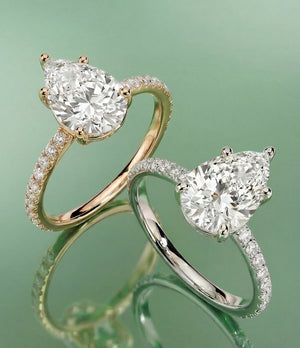
Our engagement rings

Diamond Color

Diamond color refers to the natural tint present in a diamond, with the most valuable diamonds being completely colorless. Even slight traces of color can impact a diamond’s overall appearance and value.

Diamonds are graded on a color scale established by the Gemological Institute of America, ranging from D (colorless) to Z (light yellow or brown). The closer a diamond is to colorless, the rarer and more desirable it is.

Color can be subtle and often difficult to notice with the naked eye, especially in higher-grade diamonds. However, as the color becomes more noticeable, it can slightly reduce the diamond’s brilliance and icy-white appearance.

When selecting a diamond, the ideal color grade depends on personal preference and budget. Many buyers choose near-colorless diamonds, as they offer a great balance between beauty and value while still appearing bright and elegant.

VS1

Very slightly included: minor inclusions at 10x, eye-clean.

Our engagement rings

Diamond Clarity

Diamond clarity refers to the presence of natural imperfections, known as inclusions (internal) and blemishes (external), within a diamond. These characteristics are formed during the diamond’s creation process deep within the earth.

Clarity is graded using a standardized scale developed by the Gemological Institute of America, ranging from Flawless (no visible imperfections under 10x magnification) to Included (visible inclusions that may affect appearance and durability).

In most cases, many inclusions are microscopic and not visible to the naked eye. Diamonds in the “eye-clean” range can appear just as beautiful as higher clarity grades, making them a popular choice for those seeking both quality and value.

When choosing a diamond, clarity should be balanced with the other 4 Cs. A diamond with slight inclusions but excellent cut and color can still look stunning and brilliant in everyday wear.

A hand with diamonds of increasing size on each finger beside a carat and diameter reference guide

Diamond Carat

Diamond carat refers to the weight of a diamond, not its physical size, although the two are often closely related. One carat is equal to 200 milligrams, and diamonds are also measured in points, where 100 points equal one carat.

While larger diamonds are generally more rare and valuable, carat weight alone does not determine a diamond’s beauty. Factors like cut, color, and clarity also play a significant role in how the diamond looks overall.

Two diamonds of the same carat weight can appear different in size depending on their cut and shape. A well-cut diamond can appear larger and more brilliant than a poorly cut one of the same weight.

When choosing a diamond, it’s important to find the right balance between carat weight and the other 4 Cs to ensure you get the best combination of size, sparkle, and value.

Three loose diamonds, a pear, a marquise and an oval, on a pale grey surface

Diamond Shape

Diamond shape refers to the overall form and outline of a diamond, and it is one of the first things people notice. Unlike cut, which focuses on how well a diamond reflects light, shape describes its physical appearance.

There are many popular diamond shapes to choose from, including round, princess, oval, cushion, emerald, pear, and marquise. Each shape has its own unique style and character, allowing you to select one that best reflects your personal taste.

The round brilliant shape is the most popular due to its exceptional sparkle, while fancy shapes like oval or pear can appear larger and offer a more distinctive look.

When choosing a diamond shape, it often comes down to personal preference, style, and how the diamond will be set in the jewelry. The right shape can enhance the overall design and make your piece truly unique.

Five yellow gold split-band solitaires with marquise, round, pear, emerald and oval diamonds

Diamond Size

Diamond size refers to how large a diamond appears to the eye, which is often influenced by both its carat weight and its cut. While carat measures the weight of a diamond, size is about its visible dimensions and overall presence.

Two diamonds with the same carat weight can look different in size depending on their shape and cut quality. For example, elongated shapes like oval or marquise may appear larger than round diamonds of the same carat weight.

The way a diamond is set in jewelry can also affect how big it looks. Settings like halo or thin bands can enhance the appearance of size, making the center stone stand out more.

When choosing a diamond, it’s important to consider not just the carat weight, but how the diamond actually looks when worn, ensuring it meets your expectations for both size and style.

Loose round brilliant diamonds of different sizes on a pale surface

Types of Diamonds

Natural Diamonds

Natural diamonds are formed deep within the Earth under intense heat and pressure over billions of years. Composed of nearly pure carbon, they are the hardest naturally occurring material known. Their rarity and natural origin make them highly valuable and timeless, often passed down through generations as a symbol of lasting beauty and tradition.

Lab-Grown Diamonds

Lab-grown diamonds are created in advanced laboratory environments using cutting-edge technology that replicates the natural diamond-growing process. They are visually, chemically, and physically identical to natural diamonds, with the only difference being their origin. Because they are more readily available, lab-grown diamonds typically offer a more affordable option while maintaining the same brilliance and durability.

The 4 C’s of Buying Diamonds FAQ

What are the 4 Cs of a diamond?

Cut, color, clarity and carat weight. Cut is how well a diamond is shaped and faceted to return light, graded from Excellent down to Poor. Color is how colorless it is, from D (colorless) to Z (light yellow or brown). Clarity is how free it is of inclusions and blemishes, from Flawless to Included. Carat is its weight: one carat is 200 milligrams.

Which of the 4Cs matters most?

Cut has the greatest effect on how a diamond looks, because it controls how well the stone returns light. A well-cut diamond can look brighter, and even larger, than a poorly cut stone with higher color or clarity grades, so many buyers prioritize cut and then balance color, clarity and carat to suit their budget.

Is carat weight the same as diamond size?

No. Carat is weight: one carat is 200 milligrams, or 100 points. How big a diamond looks also depends on its shape, its cut and its setting, so an oval or marquise can look larger than a round diamond of the same weight. Our diamond size chart shows the millimeter size of each shape by carat.

What clarity grade is eye-clean?

Clarity grades run from Flawless (FL) and Internally Flawless (IF) through VVS1–VVS2, VS1–VS2 and SI1–SI2 to Included (I1–I3). Many VS diamonds, and some SI1 diamonds, show no inclusions to the naked eye, but this varies from stone to stone, so it is worth judging each diamond individually.

What color grade looks colorless?

Diamonds graded D to F are colorless, and G to J are near-colorless. Once set, near-colorless diamonds usually look white to the naked eye, particularly in yellow or rose gold, which is why many buyers choose them for value.

What are the best color and clarity grades for the money?

Many buyers choose a near-colorless color grade (G to J) and an eye-clean clarity grade, often in the VS range or a carefully checked SI1. Once set, these diamonds usually look white and clean to the naked eye, especially in yellow or rose gold, and they leave more of the budget for cut and carat.

Does a bigger carat always cost more?

Price generally rises with carat weight, and it tends to step up at popular weights such as 0.50, 1.00 and 2.00 carats. Cut, color and clarity matter just as much, though: a smaller diamond with stronger grades can cost more than a larger one with weaker grades.

Do fancy-shaped diamonds get a cut grade?

Usually not. GIA and IGI give an overall cut grade to round brilliant diamonds. For ovals, pears, marquises and other fancy shapes, judge the cut by the polish and symmetry grades and the proportions on the report, such as the depth percentage and the length-to-width ratio. Our diamond proportion and ratio guide shows what to look for.

Do the 4 Cs apply to lab-grown diamonds?

Yes. A lab-grown diamond is real diamond, so its beauty still comes down to cut, color, clarity and carat. IGI grades lab-grown diamonds on the same 4 Cs as natural diamonds, while GIA has described them as Premium or Standard since October 2025. At the same grades, a lab-grown diamond costs less than a natural one. What Are Lab Grown Diamonds? explains how they are made.