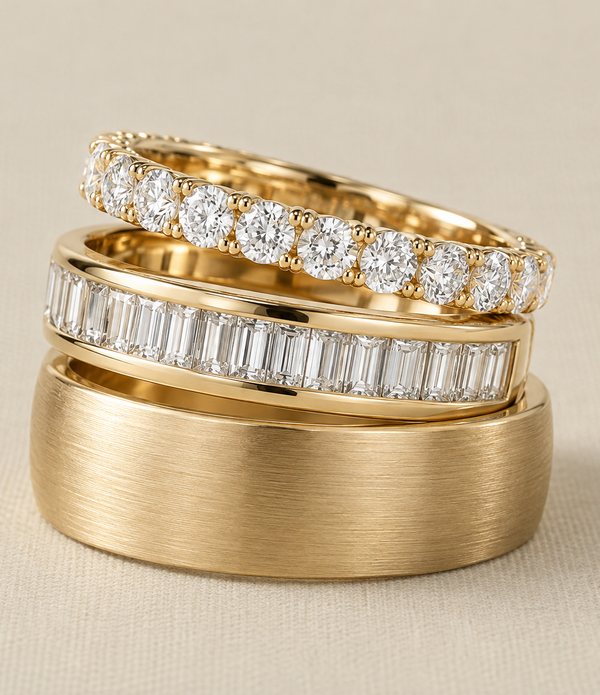
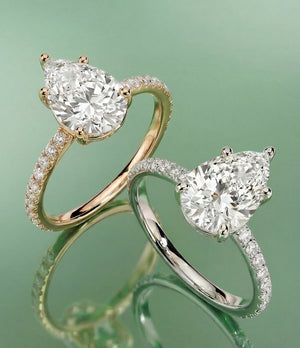
A pear-shaped diamond engagement ring with a pavé band beside a plain yellow gold wedding band on green stone

Education 15 min read Updated

Bridal Basics: Engagement Ring vs. Wedding Ring

One ring asks the question; the other keeps the promise. Here is how engagement rings and wedding rings differ in meaning, design, and timing, how to wear and pair them, and what to know before you buy either one.

An engagement ring is given at the proposal and is built around a center stone, usually a diamond, raised in a setting. A wedding ring, or wedding band, is exchanged during the ceremony: a simpler, lower band, and usually worn by both partners. Most people wear both on the fourth finger of the left hand, traditionally with the wedding band first, closest to the heart.

The experts you can trust: Our Chicago studio handcrafts both engagement rings and wedding bands, so we see every day how the two rings work together and where couples tend to get stuck. Keep reading, or book a video or phone appointment and we will walk you through it.

What Is the Difference Between an Engagement Ring and a Wedding Ring?

What Is the Difference Between an Engagement Ring and a Wedding Ring?

The short answer: an engagement ring is given at the proposal, and a wedding ring is exchanged at the ceremony. One marks the promise to marry, the other marks the marriage itself. Most people wear both on the same finger, which is why it pays to plan them together from the start.

The engagement ring is traditionally given by one partner to the other when they propose, and it is usually the more decorative of the two. It is built around a center stone, most often a diamond, raised in a setting designed to catch the light. Because it is chosen first, often many months before the wedding, it sets the style that the wedding ring will later need to complement.

The wedding ring, also called a wedding band, is exchanged during the ceremony itself, usually as the couple says their vows. It is simpler by design: a continuous circle of metal, sometimes set with small diamonds, made to be worn every day without a second thought. And unlike the engagement ring, wedding bands are usually exchanged by both partners, so most couples are shopping for two.

One is the statement and the other is the foundation, and when they are planned together they read as a single, finished look on the hand.

A Brief History of Both Rings

A Brief History of Both Rings

Rings have marked commitment for thousands of years. A circle has no beginning and no end, so it has long stood for eternity, and the ancient Egyptians are often credited with first exchanging rings as a symbol of lasting love.

The engagement ring as we know it traces back to ancient Rome, where a betrothal ring, often made of iron and later of gold, was given as a public pledge that a marriage had been agreed. The diamond came much later. In 1477, Archduke Maximilian of Austria gave Mary of Burgundy a ring set with diamonds, one of the earliest recorded diamond engagement rings, and the idea slowly spread through the courts of Europe. Diamond engagement rings became an everyday expectation only in the twentieth century, helped along by an ambitious diamond advertising campaign that began in the late 1930s.

The wedding band has its own story. For centuries it was usually the bride alone who received one. Double-ring ceremonies, where both partners exchange bands, became common in the United States during and after the Second World War, as jewelers promoted them and servicemen heading overseas wanted a reminder of the wife waiting at home. Today, most couples exchange two bands.

Knowing where these customs come from makes it easier to decide which ones matter to you and which you would rather make your own.

How to Wear Your Engagement Ring and Wedding Band

How to Wear Your Engagement Ring and Wedding Band

In the United States and much of the English-speaking world, both rings are worn on the fourth finger of the left hand, the one we call the ring finger. The custom is often traced to the vena amoris, or vein of love, an old belief that a vein ran from that finger straight to the heart. The anatomy did not hold up, but the tradition did.

Which ring goes first? Traditionally, the wedding band goes on first, at the base of the finger, with the engagement ring above it, so the band sits closest to the heart. Plenty of people reverse the order because they prefer how it looks or feels, and some sandwich the engagement ring between the wedding band and a later anniversary band. There is no wrong answer, only what sits comfortably and looks right to you.

On the wedding day, many brides move the engagement ring to the right hand before the ceremony so the band can slide on freely during the vows. Afterward, the engagement ring goes back on the left hand, on top of the new band.

Cultural variations

  • In Germany, Norway, Russia, Poland, and Greece, wedding rings are traditionally worn on the right hand.
  • In some countries, including Brazil, couples wear their rings on the right hand while engaged and move them to the left once they marry, so the hand itself shows whether someone is engaged or married.
  • In a traditional Jewish ceremony, the ring is placed on the bride's right index finger, and many brides move it to the left ring finger afterward.
Design Differences: Center Stone, Profile, and Width

Design Differences: Center Stone, Profile, and Width

Set the two rings side by side and the differences are easy to see, because each one is built for a different job.

  • Center stone versus band. An engagement ring is designed around its center stone, the focal point the rest of the ring exists to show off. A wedding band usually has none. Its beauty comes from the metal itself, or from a line of smaller diamonds across the top or all the way around.
  • Profile and setting height. The center stone of an engagement ring is held in a head, usually prongs or a bezel, that raises it above the band. That height makes room for the stone's pointed base and shows it off, but it also means the ring can catch on gloves, knits, and hair. A wedding band sits low and close to the skin, which makes it easy to wear every day.
  • Width. The band of an engagement ring, called the shank, is often kept slim, commonly around 1.5 to 2.5 millimeters, so the center stone looks as generous as possible. Women's wedding bands commonly run from about 1.5 to 3 millimeters, while men's bands are usually wider, often 4 to 8 millimeters.
  • Construction. Engagement rings often carry architectural details around and beneath the stone, such as cathedral shoulders, a hidden halo, or an open gallery. A wedding band's details live on its surface and inside: a polished, brushed, or hammered finish, pavé or channel-set diamonds, and often a rounded comfort-fit interior.

Every Mine & Grown center stone comes with an IGI or GIA grading report, so you will know exactly what sits at the heart of your engagement ring. For a closer look at band styles, see Wedding Ring Types 101, and for the vocabulary of shanks, heads, and galleries, see Ring Anatomy 101.

Engagement Ring vs. Wedding Ring

A side-by-side look at how the two rings differ, from what they mean to how they fit.

FeatureEngagement RingWedding Ring
Purpose

A promise to marry

A symbol of the marriage itself

When It's Given

At the proposal, often months before the wedding

During the wedding ceremony, usually with the vows

Typical Design

A slim band built to show off a raised stone, often with prongs, a halo, or side stones

A continuous band of metal, plain or set with smaller diamonds

Center Stone

Usually; a diamond is the most popular choice

Usually none; any diamonds are small and set into the band

Setting Height

Usually raised above the band to show off the stone

Low and close to the finger for everyday wear

Typical Width

Often about 1.5 to 2.5 mm at the shank

About 1.5 to 3 mm for most women's bands; 4 to 8 mm for most men's

Who Wears It

Traditionally one partner, though rings for both are increasingly common

Usually both partners

Resizing

Ours include one complimentary fit adjustment of up to 1.5 sizes

Ours can be resized for a service fee; eternity bands cannot be resized

How to Pair Your Engagement Ring and Wedding Band

How to Pair Your Engagement Ring and Wedding Band

Because the two rings will sit side by side every day, the best time to think about the wedding band is while you are choosing the engagement ring. A handful of details decide whether they look like a set or like strangers.

  • Matching bridal sets. The simplest route is a set designed together, where the band's width, profile, and stones are matched to the engagement ring from the start. Everything lines up, with no guesswork.
  • Contoured and curved bands. If the center stone sits low, or the setting has a halo or a wide basket that reaches down toward the finger, a straight band may not sit snugly beside it. A contoured band curves or notches around the setting so the two rings nestle together. Curved bands are also a design choice in their own right, framing an oval, pear, or marquise with a sweep of metal or diamonds.
  • Flush fit. Many people want the band to sit flush against the engagement ring with no gap. Whether that is possible depends on how low the setting sits and whether its basket or halo reaches down to where the band would rest. If a flush fit matters to you, ask about it before you buy the engagement ring, not after.
  • Metal and karat. Match the metal color for a seamless look, and ideally match the karat too. Rings worn together rub against each other all day, and alloys of different hardness wear at different rates, so a 14k band beside an 18k engagement ring, or gold beside platinum, can wear unevenly over time. Mixed metals can look beautiful; just go in knowing the trade-off.
  • Width and balance. A band about the same width as the engagement ring's shank usually looks most balanced. A much wider band can overpower a delicate solitaire, while a whisper-thin band can disappear next to a bold setting.
  • Stacking. Many people add bands over the years for anniversaries and milestones. If that is the plan, a clean, simple first band makes every later addition easier. Our Ring Stacking 101 guide covers spacing and balance as the stack grows.
Do You Need Both Rings? Modern Alternatives

Do You Need Both Rings? Modern Alternatives

Wearing two rings is a tradition, not a requirement. More couples are choosing what suits their hands, their work, and their style, and each of the options below is just as meaningful as the classic pair.

  • One ring that does both jobs. Some people love their engagement ring so much that it simply becomes their wedding ring too, with nothing added at the ceremony. Others skip the traditional engagement ring and propose with a diamond band.
  • An eternity band. A band set with diamonds all the way around is a popular wedding ring on its own, and a natural single ring for anyone who wants sparkle without a raised center stone. Half-eternity bands, with stones across the top only, offer a similar look with plain metal underneath.
  • The band as the everyday ring. Nurses, chefs, athletes, and anyone who works with their hands often wear only the wedding band day to day and save the engagement ring for evenings and weekends.
  • Men's bands and engagement rings. Most grooms wear just a wedding band, usually wider and heavier than a bride's, often with a polished, brushed, or textured finish. Engagement rings for men are becoming more common too, and some couples exchange two engagement rings.
  • Bands that don't match each other. Partners' wedding bands do not have to be twins. A shared metal, a shared finish, or a hidden engraving inside can tie two very different rings together.

Whatever you choose, the meaning comes from the commitment, not the count.

Budgeting and Timing: When to Buy Each Ring

Budgeting and Timing: When to Buy Each Ring

The two rings are usually bought months apart, and planning for both at the start keeps the second purchase from turning into a scramble.

The engagement ring comes first. Give yourself a comfortable runway before the proposal. Custom and made-to-order pieces take about four to six weeks to craft, so if you have a date in mind, start early enough to allow for production, shipping, and a little breathing room. Shipping within the US is free via FedEx. For the whole process in order, see 5 Essential Steps: The Engagement Ring Roadmap.

Wedding bands come later. Aim to choose your bands about three months before the wedding. That covers made-to-order production, any engraving, and a final check on fit, without the decision landing in the busiest weeks of planning. Have your engagement ring with you when you shop, including on a video appointment with us, so you can see how each band looks beside it.

Budget for the full set. The engagement ring usually takes the larger share of the ring budget, since it carries the center stone, but remember to set aside enough for two wedding bands, one for each partner. Choosing a lab-grown diamond is one of the simplest ways to make the whole budget go further, leaving more room for the bands. Our Engagement Ring Budgeting 101 guide goes deeper on setting a number.

Finalize the details before you order. Custom, engraved, and made-to-order pieces are final sale, so confirm sizes, metals, and any engraving text first. Unworn premade pieces can be returned within 30 days, with shipping costs deducted from the refund.

Sizing and Caring for Both Rings

Sizing and Caring for Both Rings

Two rings worn together for decades need a little planning on size and a little attention on care.

Getting the size right

  • Measure when your hands are at a normal temperature, ideally later in the day. Fingers swell in heat and after exercise and shrink in the cold, which is worth remembering in a Chicago summer.
  • Wider bands fit more snugly than thin ones, so a wide men's band may need a slightly larger size than a slim ring on the same finger.
  • Not sure of your size? Request a free physical ring sizer from our Ring Size page and measure at home.

What can be resized

  • Mine & Grown engagement rings include one complimentary fit adjustment of up to 1.5 sizes.
  • Wedding bands and standard pieces can be resized for a service fee.
  • Eternity bands cannot be resized, because the stones run continuously around the band. Measure with extra care before ordering one.

Everyday care

Take both rings off for the gym, heavy cleaning, gardening, and swimming, and store them apart in a lined box so they do not scratch each other. A soak in warm water with a drop of mild dish soap, followed by a gentle brush with a soft toothbrush, brings back the sparkle. Check prongs and pavé every so often for anything that feels loose. Our 3-year warranty covers manufacturing flaws, including a one-time replacement of accent stones up to 0.10 carat. For more, see How to Care for Your Engagement Ring.

Engagement Ring vs. Wedding Ring FAQ

What is the difference between an engagement ring and a wedding ring?

An engagement ring is given at the proposal and usually features a center stone. A wedding ring is exchanged during the ceremony and is usually a simpler band. One marks the promise to marry and the other marks the marriage itself, and many people wear both together on the same finger.

Which goes on first, the engagement ring or the wedding band?

Traditionally the wedding band goes on first, at the base of the finger and closest to the heart, with the engagement ring above it. Wearing them the other way around is perfectly fine, so choose whichever feels comfortable and looks right to you.

Should I wear my engagement ring during the wedding ceremony?

You don't have to. Many people switch it to the right hand for the ceremony so the band can go on first, then return it to the left hand, above the band, afterward. Others leave it with a trusted attendant for the day. Choose whatever keeps the moment simple.

Do you keep wearing your engagement ring after the wedding?

Most people do, wearing it together with the wedding band on the same finger, usually above the band. Some wear only the band day to day, such as nurses, chefs and anyone who works with their hands, and save the engagement ring for evenings and weekends.

Does my wedding band have to match my engagement ring?

No. Your band can differ in style or finish from your engagement ring. What matters is how the two sit together: matching the karat helps them wear evenly where they rub, and a low or halo setting may need a contoured band to sit flush. If you can, see them together on your hand before you decide.

What is a bridal set?

An engagement ring and wedding band designed together, so the band's width, profile and stones match the engagement ring and the two sit neatly side by side. If your engagement ring has a low setting or a halo, a contoured band that curves around it may be needed for the two to sit flush.

Do men wear engagement rings?

Some do. Engagement rings for men are becoming more common, and some couples exchange two engagement rings. Most grooms wear just a wedding band, usually wider than a bride's, often 4 to 8 millimeters, with a polished, brushed or textured finish. See our men's wedding bands.

When should we buy our wedding bands?

Aim for about three months before the wedding. Made-to-order pieces take about four to six weeks to craft, so that leaves time for production, any engraving, and a final fit check. Custom, engraved, and made-to-order pieces are final sale, so confirm your size and details before you order.

Can an eternity band be resized?

No. Because the diamonds run continuously around the band, eternity bands cannot be resized, so measure carefully before you order. Request a free physical ring sizer from our Ring Size page and measure at a normal temperature, later in the day. If you expect your size to change, a plain band, which can be resized for a fee, may be the more practical choice.

Can one ring serve as both my engagement ring and my wedding ring?

Yes. Some people keep wearing their engagement ring on its own after the wedding, and others propose with a diamond band or an eternity band that does both jobs from the start. There is no rule that says you need two rings, so choose what you will be happy wearing every day.