An oval diamond ring in a yellow gold split band worn on the ring finger

Education 8 min read

What Hand Does the Engagement Ring Go On?

The Left Hand, the Ring Finger and the Traditions Behind Them

In the United States the engagement ring goes on the fourth finger of the left hand, the ring finger, and the wedding band joins it there. Here is where that custom comes from, which countries wear their rings on the right hand instead, which ring goes first, what to do on the wedding day and how to make the choice your own.

The experts you can trust: Mine & Grown guides are written with jewelry experts and reviewed for accuracy. Questions about a specific piece? Our team is happy to help.

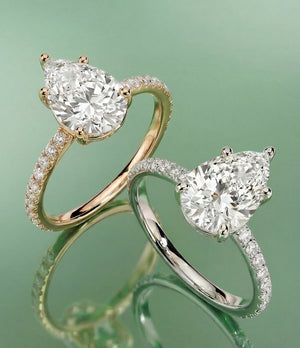
Lumi pear engagement ring worn on the hand

The Short Answer

In the United States, Canada, the United Kingdom, Australia and much of Western Europe, the engagement ring is worn on the fourth finger of the left hand, counting the thumb as the first. That finger is called the ring finger.

After the wedding, the wedding band goes on the same finger, and most people wear the two rings together. In some countries, including Germany, Norway, Poland, Russia and Greece, the wedding ring is traditionally worn on the right hand instead.

There is no rule you have to follow. The left ring finger is the custom, not a requirement, and many people choose a different hand or finger for comfort, work or personal meaning.

Which Hand Around the World

WhereEngagement ringWedding ringGood to know
United States, Canada, UK, Ireland, AustraliaLeft handLeft handThe band usually sits below the engagement ring
France and ItalyLeft handLeft handSame custom as the US
GermanyOften the left handTraditionally the right handThe engagement ring may move to the right with the band
Norway and DenmarkVariesTraditionally the right hand
Poland, Russia, Ukraine and GreeceVariesTraditionally the right handA custom in many Orthodox Christian countries
IndiaVariesOften the right handMany couples now wear rings on the left
BrazilRight hand, as a matching bandMoved to the left handThe engagement band changes hands at the wedding
Jewish ceremoniesVariesPlaced on the right index finger in the ceremonyOften moved to the left ring finger afterward
Why the Left Hand?

Why the Left Hand?

The best-known explanation goes back to ancient Rome. Romans believed a vein ran directly from the fourth finger of the left hand to the heart, the vena amoris or "vein of love", so a ring on that finger was a ring closest to the heart. Anatomy does not bear it out, since the veins of every finger connect to the heart in the same way, but the idea has lasted for about two thousand years.

Religious custom carried it forward. The Church of England's Book of Common Prayer of 1549 told the groom to place the ring on the fourth finger of the bride's left hand, and English-speaking countries kept the custom.

There is a practical reason too: most people are right-handed, so a ring on the left hand is knocked less, scratched less and gets in the way less during the day.

Luna marquise solitaire engagement ring worn on the hand

Which Finger Is the Ring Finger?

The ring finger is the fourth finger, between the middle finger and the little finger. Counting from the thumb, it is finger number four; counting only fingers, it is the third. On the left hand it is the traditional home of both the engagement ring and the wedding band.

A ring on the ring finger sits naturally: the finger moves less than the index or middle finger, so the ring stays in place without rubbing its neighbors. Our Ring Anatomy 101 explains the parts of a ring and how each one sits on the finger.

Engagement Ring and Wedding Band: Which Goes First?

Engagement Ring and Wedding Band: Which Goes First?

The traditional order puts the wedding band on first, closest to the hand, with the engagement ring above it, toward the fingertip. The idea is that the band, the symbol of the marriage itself, sits closest to the heart, and the engagement ring "guards" it from the outside.

Plenty of people wear them the other way, with the engagement ring below the band, because they like how it looks, because the engagement ring sits more securely or simply because it went on first. Both are correct. What matters more is that the two rings sit well together: some engagement rings need a curved or notched band to sit close, and a straight band suits a ring whose diamond sits high above the band.

Our guide Bridal Basics: Engagement Ring vs Wedding Ring explains how the two rings differ and how to choose them as a set.

Wearing Your Rings on the Wedding Day

Wearing Your Rings on the Wedding Day

  1. Before the ceremony, move your engagement ring to the ring finger of your right hand, or hand it to someone you trust. That leaves the left ring finger free for the band.
  2. During the ceremony, your partner places the wedding band on your left ring finger.
  3. After the ceremony, slide the engagement ring back onto the left hand, above the band if you follow the traditional order.

Some people wear only the band for the ceremony and the photos, then add the engagement ring at the reception. Others have the two rings soldered together into one set after the wedding, so they always sit aligned; a jeweler can do this, and it can be undone later if you want to wear them separately.

An oval diamond solitaire engagement ring worn on the ring finger of the right hand

Right Hand, Left-Handed and Other Choices

  • Left-handed? Some left-handed people wear their rings on the right hand so they knock and scratch them less. Either hand is fine.
  • Work and sport. If your work is hard on your hands, as in healthcare, cooking, trades or the gym, you may wear your rings on a chain or a different hand during the day, or keep the engagement ring for evenings and wear a plain band to work.
  • Two engagement rings. Couples who both wear engagement rings usually wear them on the left ring finger, but there is no rule; choose what feels right to you both.
  • Heritage. Many couples keep the custom of their family's country, for example a right-hand wedding ring, or wear rings on both hands to honor two traditions.
  • Right-hand rings. A ring worn on the right hand outside these traditions, a cocktail ring or a stacking ring, is not read as an engagement ring in most English-speaking countries.
Men's Engagement and Wedding Rings

Men's Engagement and Wedding Rings

The same customs apply to men's rings. In the US a man's wedding band goes on the left ring finger, and so does an engagement ring if he wears one; in countries with the right-hand tradition, his band goes on the right.

Men's wedding bands tend to be wider than women's, often 5 to 8 mm, and a wide band feels snugger, so it is often sized a quarter to a half size larger than a thin band on the same finger. Finish matters too: a polished band shows scratches sooner than a brushed or hammered one. Wedding Ring Types 101 covers band styles, widths and finishes.

Getting the Fit Right on the Ring Finger

Getting the Fit Right on the Ring Finger

Size the hand you will actually wear the ring on. Fingers on your dominant hand are often slightly larger, so a ring sized for the right hand may slip on the left.

  • Measure at the end of the day, when fingers are at their usual size, not first thing in the morning or after exercise.
  • Mind the weather. Fingers swell in heat and shrink in cold, so a ring that is snug in summer can spin in winter.
  • The knuckle decides. The ring should slide over the knuckle with a little resistance and sit without spinning.
  • Wider bands need more room. If you plan a wide wedding band, size for it separately.

Read How to Size Your Ring, or, if it's a surprise, How to Find Out Someone's Ring Size Without Asking Them.

Stacking Rings on the Ring Finger and Beyond

Stacking Rings on the Ring Finger and Beyond

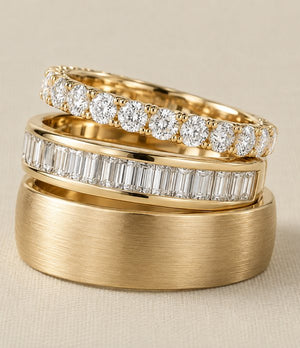
The engagement ring and wedding band are the start of most stacks. Some people add an anniversary or eternity band on the same finger over the years; others move extra rings to the middle finger or the other hand so the ring finger stays simple. A good stack mixes widths and textures and keeps the engagement ring the focus.

Every Mine & Grown engagement ring is made to order in our Chicago studio in about 4 to 6 weeks, in 14k or 18k gold or platinum, with a lab-grown or natural center diamond and an IGI or GIA report. If you want help planning how your rings will sit together, Yareli, our founder and designer, can go through it with you by video or phone. Ring Stacking 101 has more ideas.

Engagement Ring Hand FAQ

What hand does the engagement ring go on?

In the US, Canada, the UK and Australia, the left hand, on the fourth finger, called the ring finger. In some countries, including Germany, Norway, Poland, Russia and Greece, the wedding ring is traditionally worn on the right hand.

Which finger is the ring finger?

The fourth finger, between the middle finger and the little finger, counting the thumb as the first.

Does the engagement ring or the wedding band go on first?

Traditionally the wedding band goes on first, closest to the hand, with the engagement ring above it. Many people wear them the other way round; both are correct.

Do you still wear your engagement ring after the wedding?

Yes, most people do. After the wedding, the band goes on the same left ring finger and the two rings are worn together, traditionally with the band closest to the hand and the engagement ring above it. Some couples have the two rings soldered into one set so they always sit aligned; a jeweler can do this, and it can be undone later.

Why is the engagement ring worn on the left hand?

The custom is traced to the Roman belief in a vena amoris, a vein of love running from the left ring finger to the heart. It is a legend rather than anatomy, but the custom stuck, helped by the 1549 Book of Common Prayer.

Where do I wear my engagement ring on my wedding day?

Move it to your right hand before the ceremony so the band can go on your left ring finger, then put the engagement ring back on your left hand afterward.

Can I wear my engagement ring on my right hand?

Yes. It is a matter of custom, not a rule. Left-handed people, people who work with their hands and couples following a right-hand tradition often choose the right hand.

What does a ring on the right ring finger mean?

It depends on where you are. In countries with a right-hand tradition, including Germany, Norway, Poland, Russia and Greece, a ring on the right ring finger is usually a wedding ring. In the US, Canada, the UK and Australia, a ring worn on the right hand, such as a cocktail ring or a stacking ring, is not usually read as an engagement or wedding ring.

What hand does a man wear a wedding ring on?

In the US, the left ring finger, the same as women. In countries with a right-hand tradition, such as Germany, Norway, Poland and Russia, men usually wear it on the right.

Should I size my ring for my left hand or my right hand?

Size the hand you will actually wear the ring on. Fingers on your dominant hand are often slightly larger, so a ring sized for the right hand may slip on the left. Measure at the end of the day, when fingers are at their usual size, and if you plan a wide wedding band, size for it separately.