A round diamond halo engagement ring with a pavé band in yellow gold on green velvet

Education 9 min read

Halo Engagement Rings: Halo vs Hidden Halo vs Solitaire

A Frame of Light, a Hidden Detail or the Diamond Alone

A halo circles the center diamond with small diamonds so it looks larger and brighter. A hidden halo tucks that row of diamonds under the stone, where it shows only from the side. A solitaire lets the center diamond stand on its own. Here is how the three compare in look, size, price, care and wedding band fit, with real figures from our own rings.

The experts you can trust: Mine & Grown guides are written with jewelry experts and reviewed for accuracy. Questions about a specific piece? Our team is happy to help.

Yellow Gold

What a Halo Engagement Ring Is

A halo engagement ring has a center diamond surrounded by a ring of small diamonds, usually set close together in tiny beads of metal. The halo follows the outline of the center stone: a circle around a round, an oval around an oval, a teardrop around a pear.

Halos are not new. Cluster rings with a large stone ringed by smaller ones were worn in the Georgian and Victorian eras and became a signature of the 1920s Art Deco period. The best-known modern example is the sapphire and diamond cluster ring Lady Diana Spencer received in 1981, now worn by the Princess of Wales. Our guide Celebrity Engagement Rings and Their Cuts has more famous rings.

Our Elysian Round is a classic halo: a round brilliant diamond in four prongs, framed by a ring of small round diamonds on a pavé band whose diamonds run partway down both sides.

Halo, Hidden Halo and Solitaire at a Glance

FeatureHaloHidden haloSolitaire
From aboveCenter diamond framed by small diamondsLooks like a solitaireThe center diamond alone
From the sideHalo and, often, a pavé bandA line of small diamonds under the stoneProngs and band
Face-up sizeA 1 carat round reads about 9.4 mm acrossSame as the diamond: 6.4 mm for a 1 carat roundSame as the diamond
SparkleThe most: a ring of extra diamonds around the centerExtra sparkle from the sideAll from the center diamond
Small diamonds to look afterManyA rowNone, unless the band is pavé
Wedding bandMay need a curved or notched bandA straight band usually sits closeA straight band usually sits flush
Best forA bigger, brighter look for the carat weightA clean look with a private detailShowing the diamond's own outline
Our designElysian RoundAurielle OvalLuna and Aurora, among others
White Gold

How Much Bigger Does a Halo Make a Diamond Look?

A halo adds a border of sparkle on every side of the center diamond. If the halo diamonds are about 1.1 mm each, with a sliver of metal on either side of them, the border adds about 1.5 mm all around. A 1 carat round, about 6.4 mm across on its own, then reads as a bright circle of roughly 9.4 mm. That is close to the width of a 3 carat round on its own, about 9.3 mm in our diamond search.

It will not look like one 3 carat diamond up close: you see a center and its frame. From a few feet away, though, the whole top of the ring reads as one larger, brighter shape. That is why a halo is a popular way to get a bigger look without paying for a bigger center diamond.

The color of the halo metal matters too. A white gold or platinum halo blends with the diamonds and makes the whole top look like one white surface; a yellow or rose gold halo outlines the center in warm metal. Our guide Understanding Diamond Size Before You Buy explains face-up size by shape.

Aurielle oval solitaire engagement ring, side profile

The Hidden Halo

A hidden halo, sometimes called an under-halo, is a row of small diamonds set around the base of the setting, just under the center stone. From above you see a solitaire; the hidden halo shows from the side, as a thin line of sparkle between the stone and the band, and catches the light when the hand turns.

Because it sits underneath, a hidden halo does not change the face-up size of the diamond. It adds sparkle and a finished, detailed look to the profile, which is the part of the ring you see most when you look down at your own hand.

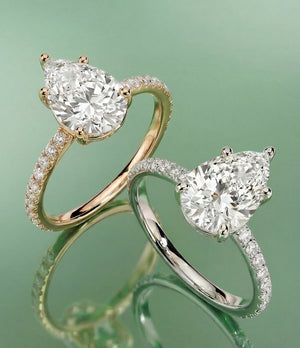
Our Aurielle Oval is a hidden halo design: an oval diamond in six slim claw prongs, with a row of small diamonds tucked beneath it, on a slim, plain band. The claws hold the oval at its ends and sides and keep most of its outline open.

White Gold

The Solitaire

A solitaire is a single diamond on a band, held by prongs or a bezel, with nothing around it. It is the most classic engagement ring, and it shows the center diamond's own outline more clearly than any other setting, which matters for shapes with a strong silhouette such as oval, pear, marquise and emerald.

With no small diamonds at the top, a solitaire is the simplest ring to clean and look after, and it pairs with almost any wedding band. The sparkle all comes from the center diamond, so its cut quality matters most. Browse our solitaire engagement rings, or read Engagement Ring Setting Types for every setting style side by side.

Which Diamond Shapes Suit a Halo?

Which Diamond Shapes Suit a Halo?

  • Round and oval. The classic halo shapes. The halo makes an even, continuous frame, and an oval halo lengthens the look of the finger.
  • Cushion. A cushion and a halo are a traditional vintage pairing that softens the square outline.
  • Pear and marquise. The halo follows the curve and the points, which protects the tips and makes these elongated shapes look even longer. Look for a prong or a V of metal at each point.
  • Emerald, Asscher and radiant. A halo with corners frames the step cuts like a picture. Many people prefer these shapes as solitaires, so their long, clean facets stay the focus.

A halo also changes how the center stone's color reads. The small diamonds sit right against it, so choose a center color grade close to theirs; a big difference can show. The The 4 Cs of Buying Diamonds explains color grades.

Rose Gold

What Does a Halo Cost?

A halo adds the small diamonds and the work of setting each one, so the same design costs more with a halo than without it. Across different designs, though, the setting style matters less than you might think, and the center diamond matters most.

In our collection in October 2026, with a 1 carat lab-grown center in 14k gold, the Elysian Round halo started at $1,574 and the Aurielle Oval hidden halo at $1,421, while our oval solitaires started at $1,364 for the Luna and $1,601 for the Aurora. With a 1 carat natural center, the same rings started at $5,104, $4,631, $4,574 and $4,812.

The bigger saving comes from the look: because a halo makes the center read larger, you can choose a smaller center diamond and still get a big presence on the hand. See How Much Does an Engagement Ring Cost in 2026? for full ring prices by carat.

Elysian round engagement ring, side profile

Everyday Wear, Care and Resizing

  • Check the small stones. Halo and pavé diamonds are held by tiny beads of metal. Have the setting checked about every six months, and sooner if you knock it hard or a stone looks dull or uneven.
  • Clean it more often. Lotion and soap collect around small diamonds and dull the halo first. Soak the ring in warm water with a drop of mild dish soap and brush gently with a soft toothbrush, under and around the halo.
  • Take it off for rough work. The gym, gardening and moving boxes are hard on any ring, and harder on dozens of small settings.
  • Resizing. Pavé that runs partway down the band, as on the Elysian, leaves the bottom of the band plain, which is the part a jeweler cuts and resizes. A band set with diamonds all the way around is much harder to resize, so get the size right first.

Read How to Care for Your Engagement Ring and How to Size Your Ring.

Pairing a Wedding Band With a Halo

Pairing a Wedding Band With a Halo

A halo is wider at the top than the band below it, so a straight wedding band may leave a small gap or sit against the halo instead of the band. There are three common answers: a band that curves around the halo, a notched band shaped to fit under it, or a straight band worn with a small gap, which many people like.

A hidden halo or a solitaire usually sits closer to a straight band, because the widest part of the setting is the diamond itself, raised above the band. If you plan to wear a band, decide on its style when you choose the engagement ring, and we can check how the two sit together before your ring is made. Ring Stacking 101 has more pairing ideas.

Elysian round engagement ring worn on the hand

How to Choose Between a Halo, a Hidden Halo and a Solitaire

  1. Decide how much sparkle you want around the center. All of it, for a halo; a little, from the side, for a hidden halo; none, for a solitaire.
  2. Think about size on the hand. A halo makes the center look much larger. A hidden halo and a solitaire show the diamond at its true size.
  3. Think about your shape. Round, oval, cushion and pear take a halo beautifully; emerald and other step cuts often shine most on their own.
  4. Be honest about upkeep. More small diamonds mean more cleaning and more prong checks.
  5. Plan the wedding band now. Choose a design and band that fit together.
  6. Ask us. Every ring is made to order in our Chicago studio in about 4 to 6 weeks, in 14k or 18k gold or platinum, with a lab-grown or natural center from 1.0 to 4.5 carats and an IGI or GIA report. Want a halo on a different shape or design? Our custom process starts with a video or phone call with Yareli, our founder and designer.

Halo Engagement Ring FAQ

What is a halo engagement ring?

A ring whose center diamond is surrounded by a ring of small diamonds that follows its outline. The halo makes the center look larger and adds sparkle around it.

What is the difference between a halo and a hidden halo?

A halo sits around the center diamond and shows from above. A hidden halo is a row of small diamonds under the center stone that shows only from the side, so from above the ring looks like a solitaire.

How much bigger does a halo make a diamond look?

Quite a lot from a distance. With halo diamonds of about 1.1 mm, a 1 carat round about 6.4 mm across reads as a bright circle of roughly 9.4 mm, close to the width of a 3 carat round on its own.

Is a halo or a solitaire more expensive?

On the same design, a halo costs more because of the extra diamonds and setting work. Across designs the center diamond matters most: in October 2026 our Elysian halo started at $1,574 and our oval solitaires at $1,364 to $1,601, each with a 1 carat lab-grown center in 14k gold.

Are halo engagement rings out of style?

No. Halos have been worn since the Georgian era and remain one of the most chosen engagement ring styles. Hidden halos and thinner halos are the more recent take for people who want a lighter look.

Can you resize a halo engagement ring?

Usually, yes, when the bottom of the band is plain metal, as on rings whose pavé runs only partway down. A band set with diamonds all the way around is much harder to resize.

Does a wedding band sit flush with a halo ring?

Not always. A halo is wider than the band below it, so a straight band may leave a small gap. A curved or notched band can fit around it, and a hidden halo or solitaire usually sits closer to a straight band.