A hand on green satin wearing a radiant-cut diamond solitaire in yellow gold

Education 5 min read

Radiant vs Oval Diamonds: Which Should You Choose?

Straight Lines or Soft Curves

Radiant and oval diamonds are both brilliant cuts that sparkle brightly. The difference is the outline: a radiant is a rectangle with trimmed corners, an oval a soft, rounded ellipse. Here is how they compare in look, face-up size, price and what to check, with real figures from our diamond search.

The experts you can trust: Mine & Grown guides are written with jewelry experts and reviewed for accuracy. Questions about a specific piece? Our team is happy to help.

Elowen radiant engagement ring in yellow gold on green velvet

Straight Lines or Soft Curves

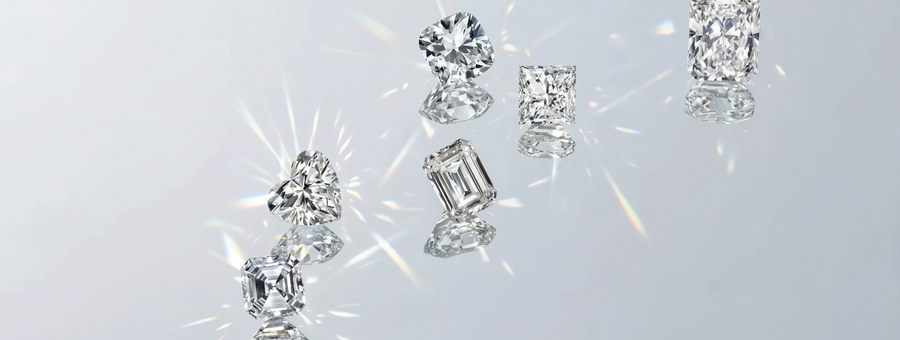
Both shapes use brilliant facets, the kind used on a round, so both sparkle brightly. A radiant has the straight outline of an emerald cut, a rectangle with trimmed corners, filled with brilliant facets. An oval keeps a round's facets in a long, softly curved outline with no corners at all.

The radiant reads as structured and contemporary; the oval as soft and romantic.

Radiant vs Oval at a Glance

FeatureRadiantOval
OutlineA rectangle with trimmed cornersA soft, rounded ellipse
FacetsBrilliant: bright sparkleBrilliant: bright sparkle
1 carat size face-up (our search)About 7.1 by 5.0 mmAbout 8.0 by 5.6 mm
2 carat size face-up (our search)About 8.9 by 6.3 mmAbout 10.1 by 7.1 mm
Typical length-to-width ratio (our search)About 1.42About 1.44
Typical 1 carat price, lab-grownAbout $440About $455
Typical 2 carat price, lab-grownAbout $950About $1,430
What to checkRatio, clarity in the photosRatio, bow tie, symmetry
A radiant cut diamond and an oval diamond of the same carat weight side by side, face up

Which Looks Bigger?

The oval. In our search a typical 1 carat oval measures about 8.0 by 5.6 mm face-up, against about 7.1 by 5.0 mm for a 1 carat radiant. At 2 carats it is about 10.1 by 7.1 mm against 8.9 by 6.3 mm. For the same carat weight, the oval spreads further across the finger.

Our guide Understanding Diamond Size Before You Buy explains face-up size.

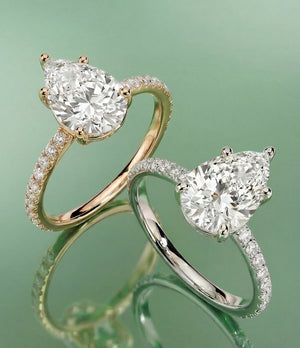
Sierra oval engagement ring in yellow gold on green velvet

Price

In our lab-grown search in October 2026, a typical 1 carat radiant cost about $440 and an oval about $455; at 1.5 carats about $625 and $650; at 2 carats about $950 and $1,430; at 3 carats about $2,585 and $1,755. The radiant cost less at 1, 1.5 and 2 carats and the oval at 3 carats, so compare prices at the size you want.

See every shape and size in Lab Grown Diamond Prices.

Elowen radiant engagement ring worn on the hand

What to Check in a Radiant

  • Ratio. The classic radiant is a rectangle of about 1.4 to 1.5; the typical 1 carat radiant in our search is about 1.42. A radiant can also be nearly square.
  • Clarity. Its many small facets break up the light and mask small inclusions, so an eye-clean radiant is often easy to find; check the photos to confirm.
  • Corners. The trimmed corners protect the stone, so a radiant can be held at its corners or, as on our Elowen, at the middle of each side.

Compare stones in our radiant diamond search, or read Emerald vs Radiant Cut Diamonds.

Luna oval solitaire engagement ring in yellow gold on green velvet

What to Check in an Oval

  • Ratio. Most people prefer 1.35 to 1.50; the typical 1 carat oval in our search is about 1.44. A lower ratio looks rounder, a higher one longer.
  • Bow tie. A darker band across the center; look for a faint one, or none, in the photos and 360° view.
  • Symmetry. Both ends should curve evenly, with the two halves matching.

Compare stones in our oval diamond search, or read Oval vs Round Diamonds.

Odessa oval bezel engagement ring in yellow gold on green velvet

Settings for Each Shape

A radiant's trimmed corners protect it, and its straight sides suit clean, modern settings; an oval has no corners, so simple prongs that show more of the stone suit it well. Our Aurora comes in both shapes, so you can compare like for like. Elowen sets a radiant east-west, across the finger, with a compass prong at the center of each side. For an oval, Luna is a classic solitaire, Odessa a bezel, Victoria a three stone ring and Nova a toi et moi.

Read Engagement Ring Setting Types for every setting style.

Elara oval three-stone bezel engagement ring worn on the hand

How to Choose Between Radiant and Oval

  1. Pick the outline you love. Straight sides and corners for a radiant; soft curves for an oval.
  2. Think about size on the hand. An oval looks larger for its weight.
  3. Think about everyday wear. An oval has no corners, and a radiant's corners are trimmed to protect them.
  4. Compare prices at your size in our diamond search; the lower price depends on the size.
  5. Ask us. Yareli, our founder and designer, can compare radiant and oval diamonds with you by video or phone.

Radiant vs Oval FAQ

Which looks bigger, a radiant or an oval?

An oval: in our search a typical 1 carat oval measures about 8.0 by 5.6 mm face-up, against about 7.1 by 5.0 mm for a 1 carat radiant.

Is a radiant cheaper than an oval?

It depends on the size. In our lab-grown search a typical 1 carat radiant cost about $440 against $455 for an oval, and at 2 carats about $950 against $1,430.

Which sparkles more, radiant or oval?

Both sparkle brightly, because both use brilliant facets. A radiant packs its sparkle into a rectangle with trimmed corners; an oval spreads it across a soft, rounded outline.

Which is more durable, radiant or oval?

Both suit everyday wear. An oval has no corners to protect, and a radiant's corners are trimmed, which protects them.

What ratio is best for a radiant and for an oval?

A classic radiant is about 1.4 to 1.5, and most people prefer an oval between 1.35 and 1.50; the typical 1 carat stones in our search are about 1.42 and 1.44.