A hand wearing a yellow gold toi et moi ring with a pear diamond and a round diamond

Education 5 min read

Round vs Pear Diamonds: Which Should You Choose?

A Circle or a Teardrop

Round and pear diamonds are both brilliant cuts, so both sparkle. The difference is the outline: a round is a perfect circle, while a pear joins a rounded end to a single point. Here is how they compare in look, face-up size, price and what to check, with real figures from our diamond search.

The experts you can trust: Mine & Grown guides are written with jewelry experts and reviewed for accuracy. Questions about a specific piece? Our team is happy to help.

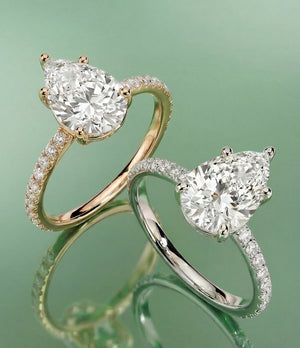
Luna pear solitaire engagement ring in yellow gold on green velvet

A Circle or a Teardrop

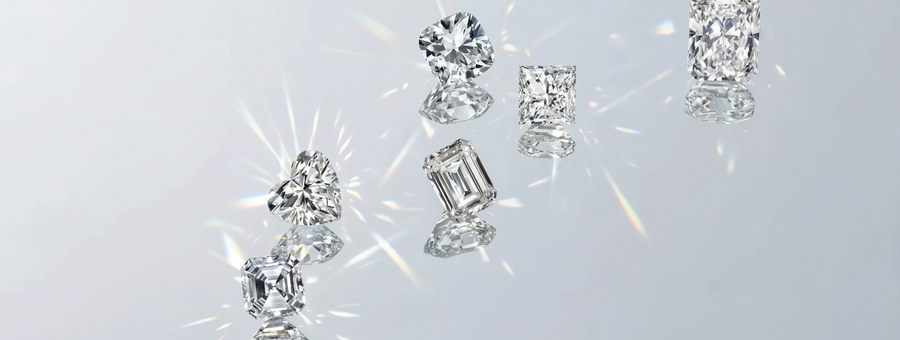
A round brilliant is cut as a circle with 57 or 58 facets, arranged to return as much light to the eye as possible. A pear, or teardrop, uses brilliant facets too, in an outline that joins a rounded end to a single point, so it also sparkles brightly.

The round reads as classic and symmetrical; the pear as graceful, with a little more direction.

Round vs Pear at a Glance

FeatureRoundPear
OutlineA perfect circleRounded at one end, a point at the other
FacetsBrilliant: the most even sparkleBrilliant: bright sparkle
1 carat size face-up (our search)About 6.4 mm acrossAbout 8.9 by 5.6 mm
2 carat size face-up (our search)About 8.1 mm acrossAbout 11.1 by 7.1 mm
Typical length-to-width ratio (our search)1.00, a circleAbout 1.60
Typical 1 carat price, lab-grownAbout $385About $410
Typical 2 carat price, lab-grownAbout $895About $1,040
What to checkCut grade firstSymmetry, ratio, the point, bow tie
A round diamond and a pear shaped diamond of the same carat weight side by side, face up

Which Looks Bigger?

The pear looks larger for its weight. In our search a typical 1 carat pear measures about 8.9 by 5.6 mm face-up, against about 6.4 mm across for a 1 carat round. At 2 carats it is about 11.1 by 7.1 mm against 8.1 mm across. The round is wider; the pear runs farther along the finger, and its point makes the hand look slimmer.

Our guide Understanding Diamond Size Before You Buy explains face-up size.

Juliette round pavé engagement ring in yellow gold on green velvet

Price

In our lab-grown search in October 2026, a typical 1 carat round cost about $385 and a pear about $410; at 1.5 carats about $570 and $660; at 2 carats about $895 and $1,040; at 3 carats about $1,385 and $1,510. Rounds cost less at every size we checked. Rounds are also the most common lab-grown shape: our search held about seven times as many comparable 1 carat rounds as pears, so there is more to choose from.

See every shape and size in Lab Grown Diamond Prices.

Estelle round engagement ring in yellow gold on green velvet

What to Check in a Round

  • Cut grade. Cut decides how much a round sparkles, so choose Excellent or Ideal.
  • Clarity and color. A round's many small facets hide inclusions well, so an eye-clean VS2 usually looks the same in a ring as a higher grade, and G or H color faces up white in most settings.
  • Prongs. Four prongs show more of the diamond; six hold it in more places.

Compare stones in our round diamond search, or read Oval vs Round Diamonds.

Celestia pear engagement ring in yellow gold on green velvet

What to Check in a Pear

  • Symmetry. The two shoulders should curve evenly down to the point.
  • Ratio. Most people choose 1.50 to 1.70; the typical 1 carat pear in our search is about 1.60. Higher looks longer and slimmer.
  • The point. Choose a setting with a prong over the tip, or a bezel around the stone, to protect it.
  • Bow tie. A darker band across the center; look for a faint one, or none, in the photos and 360° view.

Compare stones in our pear diamond search, or read Pear vs Oval Diamonds.

Eclipse pear engagement ring in yellow gold on green velvet

Settings for Each Shape

A round sits in four or six prongs and suits almost any setting. A pear needs its point protected, by a prong over the tip or a bezel, a thin rim of metal around the stone. Many of our designs come in both shapes, so you can compare like for like: Estelle as a split-shank solitaire, Juliette on a pavé band, Celestia on a V-shaped band, Isadora as a sculptural bypass and Eclipse on a band that coils around the finger. Or wear both: our Nova and Amira toi et moi rings pair a pear with a round diamond.

Read Engagement Ring Setting Types for every setting style.

Valencia round three-stone bezel engagement ring worn on the hand

How to Choose Between Round and Pear

  1. Pick the outline you love. A perfect circle for a round; a teardrop with one point for a pear.
  2. Decide how much sparkle matters. A well-cut round gives the most even sparkle; a pear sparkles brightly too.
  3. Think about size on the hand. A pear looks longer and larger for its weight.
  4. Think about everyday wear. A round has no point to protect; a pear's point needs a prong or bezel.
  5. Compare prices at your size in our diamond search; rounds cost less at every size we checked.
  6. Ask us. Yareli, our founder and designer, can compare round and pear diamonds with you by video or phone.

Round vs Pear FAQ

Which looks bigger, a round or a pear?

A pear: in our search a typical 1 carat pear measures about 8.9 by 5.6 mm face-up, against about 6.4 mm across for a 1 carat round.

Is a pear diamond cheaper than a round?

Not in our lab-grown search. A typical 1 carat pear cost about $410 against $385 for a round, and at 2 carats about $1,040 against $895.

Which sparkles more, round or pear?

A well-cut round gives the most even sparkle of any shape. A pear is a brilliant cut too and sparkles brightly, but it can show a bow tie, a darker band across the center.

Which is more durable, round or pear?

A round, because it has no point. A pear is durable too when its point sits under a prong or inside a bezel.

What ratio is best for a pear diamond?

Most people choose 1.50 to 1.70; the typical 1 carat pear in our search is about 1.60. Higher looks longer and slimmer. A round is always 1 to 1.