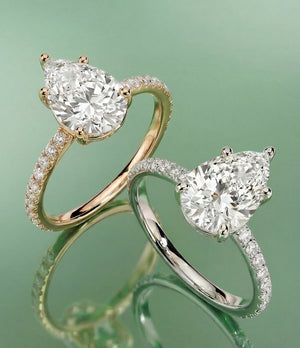
A pear-shaped diamond set at an angle in a curved yellow gold band on green velvet

Education 9 min read

CVD vs HPHT Lab-Grown Diamonds: What's the Difference?

Two Ways to Grow the Same Diamond

Every lab-grown diamond is made in one of two ways: HPHT, which recreates the crushing heat and pressure deep inside the earth, or CVD, which builds a diamond layer by layer from a carbon-rich gas. Both make real diamond. Here is how each works, how they differ in color, clarity, treatment and price, and what 52 grading reports from our own diamond search show.

The experts you can trust: Mine & Grown guides are written with jewelry experts and reviewed for accuracy. Questions about a specific piece? Our team is happy to help.

The Short Answer

The Short Answer

HPHT (high pressure, high temperature) and CVD (chemical vapor deposition) are the two ways diamonds are grown in a laboratory. Both produce real diamond, the same crystal of carbon as a mined diamond, with the same hardness, brilliance and fire.

Once a diamond is cut, polished and graded, the method no longer decides how it looks. A CVD and an HPHT diamond with the same cut, color and clarity grades look the same in a ring, and no one can tell them apart without laboratory instruments. Choose on the grades and the stone in front of you; the method is useful background, not a measure of quality.

The method is printed on the grading report. Of the 52 IGI reports we read from our own search in October 2026, 35 stones were grown by HPHT and 17 by CVD.

CVD vs HPHT at a Glance

FeatureHPHTCVD
How it growsCarbon dissolves in molten metal and crystallizes on a small diamond seedCarbon from a gas settles on flat diamond seed plates, layer by layer
PressureAbout 50,000 to 60,000 times the air pressure at sea levelBelow normal air pressure, in a vacuum chamber
TemperatureAbout 1,300 to 1,600 °CRoughly 700 to 1,200 °C
Crystal shape as grownA blocky cube and octahedronA flat, square tablet
Typical inclusionsTiny specks of metal from the growthDark pinpoints of carbon and faint growth lines
Diamond typeType II: almost no nitrogenType IIa: almost no nitrogen
After growthOften sold as grownOften heated after growth to improve color; IGI marks untreated stones As Grown
Share of our sample (October 2026)35 of 52 (67%)17 of 52 (33%)
Looks in a ringThe same at the same gradesThe same at the same grades
A rough diamond crystal held in steel tweezers above dark slate

How HPHT Diamonds Are Grown

HPHT copies the conditions in which natural diamonds form, about 150 kilometers underground. A small diamond seed is placed in a growth cell with a source of carbon and a metal such as iron, nickel or cobalt. A large press squeezes the cell to roughly 50,000 to 60,000 times normal air pressure while it is heated to about 1,300 to 1,600 °C. The metal melts and dissolves the carbon, which then crystallizes, atom by atom, onto the seed.

HPHT is the older method. General Electric produced the first reproducible lab-grown diamonds this way in 1954, and the first gem-quality stones in 1971. Modern presses can grow large, very white diamonds in days to weeks. Because of how the crystal grows, it comes out of the press as a blocky shape with cube and octahedron faces.

Three thin square CVD lab-grown diamond plates beside steel tweezers on a black tray

How CVD Diamonds Are Grown

CVD grows a diamond from a gas instead of a melt. Thin, flat slices of diamond are laid in a vacuum chamber, which is filled with a mix of mostly hydrogen and a little methane, a gas that contains carbon. Microwaves turn the gas into a glowing plasma that breaks the molecules apart, and the carbon atoms settle onto the seed plates, building the diamond up in thin layers, usually over several weeks, at roughly 700 to 1,200 °C and less than normal air pressure.

The result is a flat, square tablet of diamond, with a rough edge of non-diamond carbon that is removed before cutting. CVD became a commercial source of gem diamonds in the 2000s, and because many seed plates can grow in one chamber, it is now one of the main ways lab-grown diamonds are made.

Color and Diamond Type

Color and Diamond Type

Most natural diamonds contain a little nitrogen, which gives them a faint yellow tint. Diamonds with almost no nitrogen are called type II, and type IIa diamonds are rare in nature, fewer than two in a hundred. Both growth methods produce type II diamonds, which is one reason lab-grown diamonds so often reach high color grades.

In our sample, the CVD reports listed Type IIa, and the HPHT reports Type II.

  • HPHT can grow very white diamonds straight from the press. A trace of boron in the growth turns a diamond blue, and some near-colorless HPHT stones carry a faint blue or gray hint for that reason.
  • CVD diamonds can come out of the chamber with a brownish tint. Many are then heated after growth, often in an HPHT press, to improve their color. The change is permanent, and labs test for it: an IGI report marks a stone with no sign of treatment "As Grown".
  • Colored lab-grown diamonds, such as pink, blue or yellow, are made with either method by adding trace elements or treating the stone after growth.
Clarity and Inclusions

Clarity and Inclusions

Both methods leave tiny clues inside the diamond, and they differ. HPHT diamonds can hold specks of the metal they grew in; enough of them can make a stone faintly attracted to a strong magnet. CVD diamonds can show dark pinpoints of carbon and faint lines from the layers they grew in.

At VS2 clarity or better these features are invisible to the eye, and labs grade both kinds on the same clarity scale as natural diamonds. Under the deep ultraviolet light gemologists use, HPHT and CVD diamonds glow in different patterns and colors, which is one of the ways laboratories identify the method. Read Beyond the Grade: How Inclusions Shape Clarity for what each clarity grade means.

Loose round diamonds on a workbench, one held in steel tweezers

What We Found in Our Diamond Search

In October 2026 we picked 100 lab-grown diamonds from our own search, 25 in each of four groups: round and oval diamonds at 1 and 2 carats, each G color or better, VS2 clarity or better, with an Excellent cut, spread evenly from the least to the most expensive stone in the group. We could open the IGI grading report of 52 of them; the other reports were not available to download, so the figures below come from those 52.

  • Growth method. 35 were HPHT (67%) and 17 were CVD (33%). Size made the biggest difference: at 1 carat, 26 of the 30 stones were HPHT, while at 2 carats, 13 of the 22 were CVD.
  • As grown. Every HPHT report was marked "As Grown - No indication of post-growth treatment". None of the CVD reports carried that line.
  • Inscription. All 52 were laser-inscribed with LG and their report number.

The mix in our search changes with size, shape and the month, because it reflects what diamond growers are supplying at the time. It is a snapshot, not a rule.

Two loose round brilliant diamonds of the same size measured with a brass gauge

Does the Method Change the Price?

Not in a predictable way. Lab-grown diamonds are priced by their 4Cs and cut quality, like natural ones, and by supply. Only the 2 carat rounds in our sample had enough of both to compare: the typical (median) HPHT stone cost about $1,410 and the typical CVD stone about $840, from 5 and 8 stones. That is one small group, so treat it as a hint about supply at the time, not a rule.

Within the same grades, the bigger price differences come from cut, measurements and how the stone faces up, so compare those first. See Lab Grown Diamond Prices for typical prices by shape and size, updated every month.

A diamond grading report on a jeweler's desk with a loose round diamond in a gem box and a 10x loupe

How to Read the Growth Method on a Report

An IGI lab-grown diamond report states the method in its comments, in words such as "This Laboratory Grown Diamond was created by Chemical Vapor Deposition (CVD) growth process" or "... by High Pressure High Temperature (HPHT) growth process". Stones with no sign of treatment after growth are marked "As Grown - No indication of post-growth treatment". The report also lists the diamond type and the laser inscription, LG followed by the report number.

GIA's lab-grown diamond reports also state the growth method; read their comments for any note on treatment. One thing to watch: HPHT is also the name of a treatment, used to improve the color of some natural and CVD diamonds after they form, so read the whole comment line rather than looking for the letters alone. IGI vs GIA explains the two reports, and How to Tell if a Diamond Is Real shows how to check a report against the stone.

Isadora marquise engagement ring worn on the hand

CVD or HPHT: Which Should You Choose?

  1. Choose the diamond, not the method. Cut, color, clarity and carat decide how a diamond looks; the method does not.
  2. Read the report. It names the method, the type and any treatment.
  3. If you prefer an untreated stone, look for the As Grown line on an IGI report.
  4. Compare stones you can see. Every diamond in our diamond search shows its photo, a 360° view where available and its full report.
  5. Ask us. Every Mine & Grown engagement ring is made to order in our Chicago studio in about 4 to 6 weeks, with an IGI or GIA report for its center diamond. Yareli, our founder and designer, can compare CVD and HPHT stones with you by video or phone.

CVD vs HPHT FAQ

Is CVD or HPHT better?

Neither is better in itself. Both grow real diamond, and a CVD and an HPHT diamond with the same grades look the same. Choose on cut, color, clarity and carat, and read the report for the method and any treatment.

How are HPHT diamonds made?

HPHT copies the conditions in which natural diamonds form. A small diamond seed is placed in a growth cell with a source of carbon and a metal such as iron, nickel or cobalt, and a large press squeezes the cell to roughly 50,000 to 60,000 times normal air pressure while heating it to about 1,300 to 1,600 °C. The metal melts and dissolves the carbon, which then crystallizes onto the seed. Modern presses can grow large, very white diamonds in days to weeks.

How are CVD diamonds made?

CVD grows a diamond from a gas. Thin, flat diamond seed plates are laid in a vacuum chamber filled with mostly hydrogen and a little methane. Microwaves turn the gas into a plasma that breaks the molecules apart, and the carbon atoms settle onto the plates, building the diamond up in thin layers, usually over several weeks, at roughly 700 to 1,200 °C. Many CVD diamonds are then heated after growth to improve their color.

Can you tell a CVD diamond from an HPHT diamond by eye?

No. Even a jeweler with a loupe cannot. Laboratories identify the method with instruments such as spectroscopy and deep ultraviolet imaging, and the grading report states it.

Which method is more common?

In our October 2026 sample of 52 IGI reports from our lab-grown diamond search, 35 were HPHT and 17 were CVD. Size made the biggest difference: at 1 carat, 26 of the 30 stones were HPHT, while at 2 carats, 13 of the 22 were CVD. The mix changes with size, shape and the month.

Are CVD diamonds treated?

Many are heated after growth to improve their color, and the change is permanent. An IGI report marks a stone with no sign of treatment As Grown: in our October 2026 sample, every HPHT report carried that line and none of the 17 CVD reports did.

Is HPHT a treatment or a growth method?

Both. HPHT is a way to grow diamonds, and the same high pressure and heat are also used to improve the color of some natural and CVD diamonds after they form. The report's comment line says which applies.

What is a type IIa diamond?

A diamond with almost no nitrogen. Most natural diamonds contain a little nitrogen, which gives them a faint yellow tint, and type IIa diamonds are rare in nature, fewer than two in a hundred. Both growth methods produce type II diamonds, one reason lab-grown diamonds so often reach high color grades; in our October 2026 sample, the CVD reports listed Type IIa and the HPHT reports Type II.

Do CVD and HPHT diamonds pass a diamond tester?

Yes, both are diamond. A few HPHT diamonds with a trace of boron conduct electricity and can read as moissanite on a multi-tester.

Which costs less, CVD or HPHT?

There is no fixed rule. Price follows the grades, cut and supply. Only the 2 carat rounds in our sample had enough of both to compare: the typical (median) HPHT stone cost about $1,410 and the typical CVD stone about $840, from 5 and 8 stones. That is one small group, so treat it as a hint about supply at the time, not a rule.